

China Clears Export Licences for NdFeB Rare-Earth Magnets Used in PMSM & IPM Motors, Easing India’s EV Supply Chain Constraints
 26 Dec, 2025
 264
264

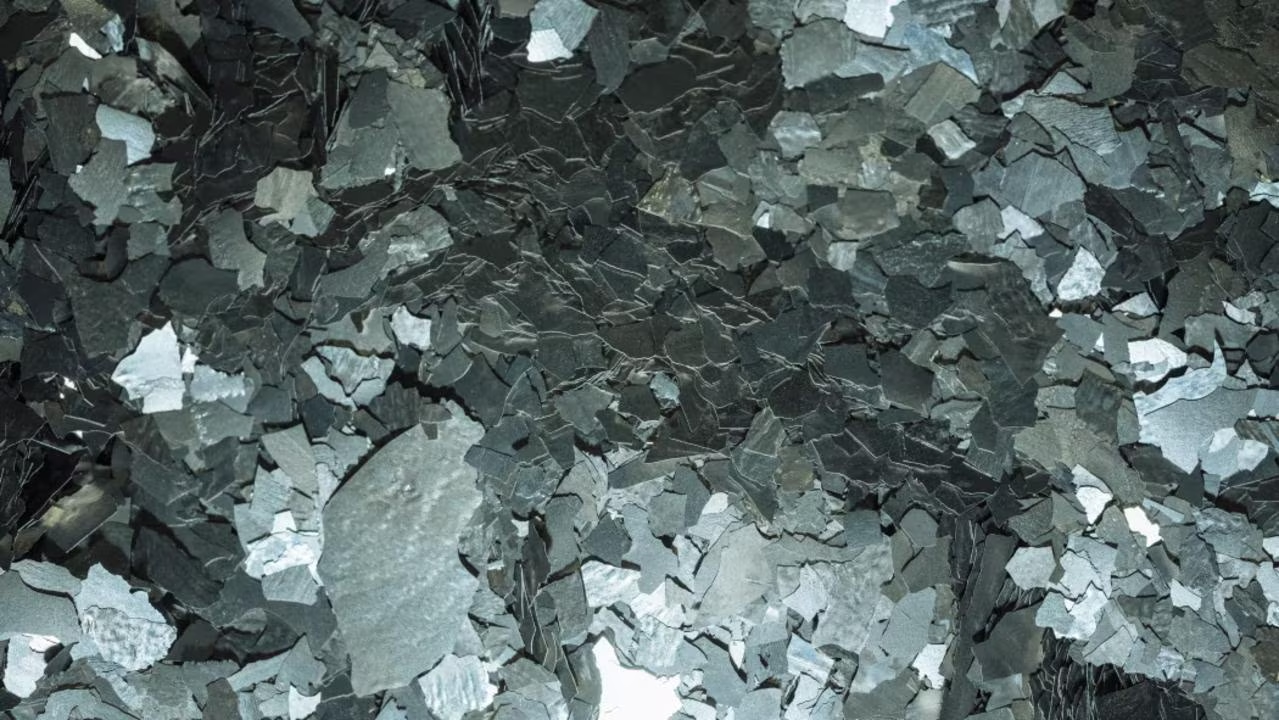
China has reportedly begun approving export licences for rare-earth permanent magnets, primarily Neodymium-Iron-Boron (NdFeB) magnets, offering critical relief to India’s electric vehicle (EV) and automotive component industry, which had been impacted by supply delays linked to export controls.
These magnets are indispensable for high-efficiency EV motor technologies, particularly Permanent Magnet Synchronous Motors (PMSM) and Interior Permanent Magnet (IPM) motors, widely used in electric passenger vehicles and two-wheelers.
Rare-Earth Magnets Covered Under the Cleared Licences
The cleared licences mainly cover sintered NdFeB permanent magnets, containing the following critical rare-earth elements:
-
Neodymium (Nd) – primary magnetic material
-
Dysprosium (Dy) – enhances high-temperature coercivity
-
Terbium (Tb) – improves thermal and demagnetization resistance
These materials are essential for motors operating at high torque, high RPM, and elevated thermal conditions, typical in EV traction applications.
EV Motor Technologies Impacted
1. Permanent Magnet Synchronous Motor (PMSM)
-
Most widely used motor type in modern EVs
-
Requires high-grade NdFeB magnets mounted on the rotor
-
Offers high power density, efficiency (>95%), and compact design
-
Used by Indian OEMs in:
-
Passenger EVs
-
Premium two-wheelers
-
Electric buses
-
2. Interior Permanent Magnet (IPM) Motor
-
Advanced PMSM variant with magnets embedded inside the rotor
-
Requires high-coercivity NdFeB magnets (Dy/Tb-doped)
-
Superior performance at high speeds and temperatures
-
Common in:
-
Long-range EVs
-
High-performance drivetrains
-
E-axles
-
Export Control & Policy Background
China classifies rare-earth materials and downstream magnet products as strategic resources under its export control framework. Exporters are required to obtain end-use-based export licences, particularly for:
-
Automotive-grade magnets
-
EV motor applications
-
Advanced electromechanical assemblies
The licences currently being cleared include approvals for:
-
Finished NdFeB permanent magnets
-
Magnet assemblies for EV traction motors
-
Magnets used in EPS (Electric Power Steering), regenerative braking systems, and e-axles
Export clearance requires:
-
End-user certification
-
Technical specification disclosure
-
Destination country declaration
Relevant HS Codes (Indicative)
The following Harmonised System (HS) codes are commonly associated with rare-earth magnets and EV motor components:
-
HS Code 8505 –
Permanent magnets and articles intended to become permanent magnets (including NdFeB magnets) -
HS Code 8501 –
Electric motors and generators (used for EV traction motors) -
HS Code 8503 –
Parts suitable for use solely or principally with electric motors
These categories are often subject to additional scrutiny and licensing when rare-earth materials are involved.
Impact on India’s EV Supply Chain
India currently imports 80–90% of its NdFeB magnet requirements, with China dominating global refining and magnet fabrication. Prior delays in licence approvals had resulted in:
-
EV motor production slowdowns
-
Longer lead times for Tier-1 suppliers
-
Cost escalation due to spot-market sourcing
With licences now being cleared:
-
Supply continuity is improving
-
EV production schedules are stabilising
-
Inventory and cost pressures are easing
Strategic Implications for India
While the immediate situation has improved, the development highlights India’s structural dependence on imported rare-earth magnets. Industry and policymakers are increasingly focusing on:
-
Domestic rare-earth separation and refining
-
Local NdFeB magnet manufacturing under Make in India
-
Recycling of rare-earth materials from end-of-life motors
-
Alternative motor technologies with reduced rare-earth intensity
Conclusion
China’s clearance of export licences for NdFeB magnets provides short-term relief to India’s EV ecosystem, particularly for PMSM and IPM motor-based platforms. However, long-term supply security will depend on India’s ability to build domestic capabilities across the rare-earth value chain and reduce strategic import dependence.
Popular posts

India's Talent behind the JIO 5G roll ou...
 The BharatBiz
20 Apr, 2024
The BharatBiz
20 Apr, 2024
 16
5191
16
5191

How to calculate GDP of a Country
The BharatBiz
02 Oct, 2023
16
5528

Positive Impact Of Demoniterization
The BharatBiz
04 Sep, 2023
16
5199