

India Ends 2025 With Record Exports and Landmark Trade Deals
 25 Dec, 2025
 258
258

Introduction
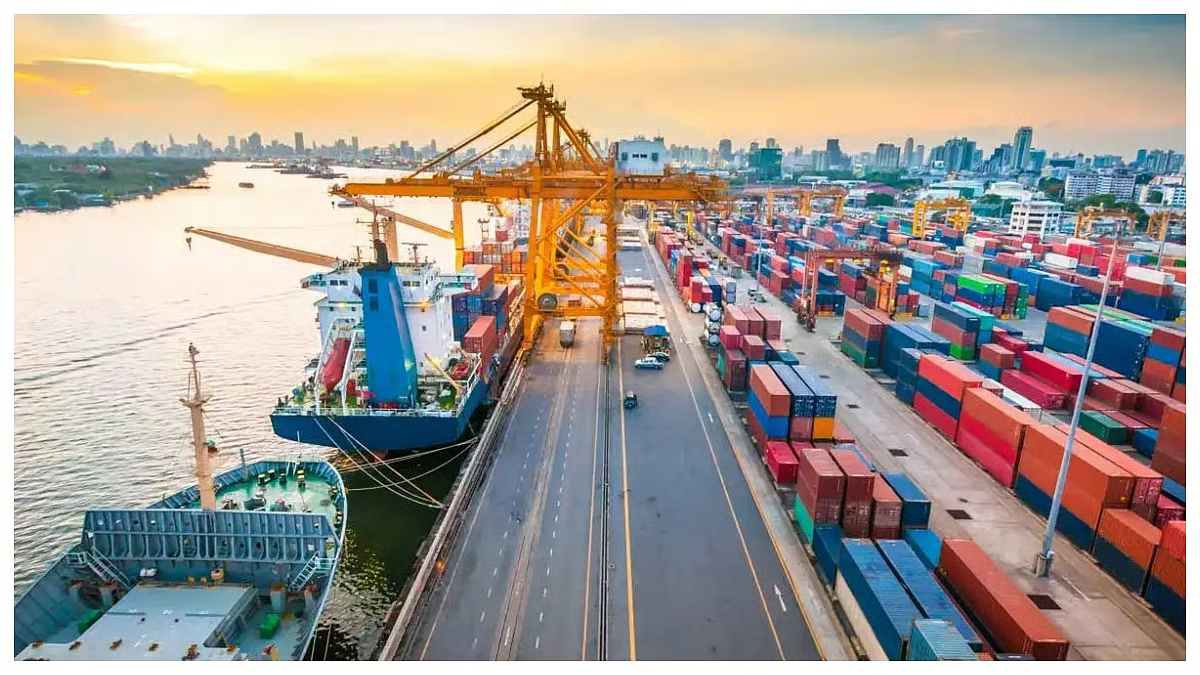
India closed 2025 on a strong economic note, recording its highest-ever exports of approximately USD 825 billion in FY 2024–25. This milestone highlights India’s deepening integration with global markets, its resilience amid geopolitical and economic uncertainties, and a focused government strategy to diversify trade partnerships. Strong performance across goods and services exports, the signing of new Free Trade Agreements (FTAs), and a decisive push toward digital trade reforms have collectively positioned India as a rising force in global commerce.
Record-Breaking Export Performance
India’s export growth during the year was driven by both merchandise and services sectors.
Goods exports benefited from sustained global demand for engineering goods, electronics, pharmaceuticals, chemicals, petroleum products, and automobiles. Manufacturing-led initiatives and improved supply chain efficiencies further strengthened India’s export competitiveness.
Services exports continued to act as a major growth engine, led by IT and IT-enabled services, business consulting, financial services, and emerging digital offerings. India’s strength in knowledge-based services helped offset global slowdowns in certain advanced economies.
Despite challenges such as inflationary pressures, supply chain disruptions, and uneven global growth, India successfully expanded market access and maintained export momentum—underscoring the resilience of its export ecosystem.
Free Trade Agreements: Expanding India’s Global Footprint
A major highlight of 2025 was the conclusion of three significant Free Trade Agreements with the United Kingdom, Oman, and New Zealand. These agreements mark a shift from traditional tariff-focused pacts to comprehensive economic partnerships covering goods, services, investment, and digital trade.
India–UK Free Trade Agreement
The India–UK FTA is among the most comprehensive trade agreements signed by India. It provides:
-
Duty reductions on Indian exports such as textiles, apparel, footwear, leather goods, pharmaceuticals, engineering products, and gems & jewellery
-
Enhanced market access for Indian IT, financial services, consulting, and professional services
-
Provisions for easier mobility of skilled Indian professionals, including short-term business visas
-
Commitments on digital trade, intellectual property protection, and regulatory cooperation, improving investor confidence
This agreement is expected to significantly boost bilateral trade volumes and strengthen India’s presence in the UK market.
India–Oman Free Trade Agreement
The India–Oman FTA strengthens India’s economic engagement with the Middle East and Gulf region, a strategically important trade and energy partner. Key features include:
-
Zero or preferential tariffs on Indian exports such as food products, chemicals, engineering goods, and pharmaceuticals
-
Improved access for Indian construction, infrastructure, healthcare, and IT services
-
Stronger cooperation in energy, logistics, ports, and industrial zones, supporting Indian businesses operating in Oman
-
Smoother trade routes connecting India to West Asia and Africa
This agreement reinforces India’s role as a reliable trade and investment partner in the Gulf region.
India–New Zealand Free Trade Agreement
The India–New Zealand FTA aims to deepen trade ties with the Asia-Pacific region and diversify export destinations. It offers:
-
Lower tariffs on Indian exports such as pharmaceuticals, textiles, auto components, and processed foods
-
Better access for Indian services professionals in education, IT, and healthcare
-
Enhanced cooperation in agri-technology, dairy processing, renewable energy, and education services
-
Support for MSMEs through simplified trade procedures and digital trade facilitation
The agreement opens new opportunities for Indian exporters in a high-income, innovation-driven economy.
Digital Trade Platforms and Policy Reforms
The government’s push toward digital trade infrastructure played a crucial role in supporting export growth. Initiatives such as paperless customs, faster clearances, and integrated export portals helped reduce transaction costs and improve ease of doing business.
Digital platforms have also enabled MSMEs and first-time exporters to access global markets more efficiently by bridging gaps in logistics, compliance, and trade finance. This digital-first approach has improved transparency, scalability, and operational efficiency across India’s trade ecosystem.
Strategic Significance for India’s Economy
The record export performance delivered broad economic benefits by:
-
Supporting employment across manufacturing and services sectors
-
Improving foreign exchange earnings
-
Strengthening India’s balance of payments position
-
Enhancing investor confidence in India’s long-term growth outlook
The export momentum aligns closely with national initiatives such as “Make in India,” “Atmanirbhar Bharat,” and supply chain diversification, reinforcing India’s image as a dependable global trade partner.
Outlook Ahead
Looking forward, India aims to cross the USD 1 trillion export mark in the coming years. Continued trade negotiations, deeper integration into global value chains, expansion of digital trade, and sustained policy reforms are expected to drive the next phase of export-led growth.
With a young workforce, expanding manufacturing base, and leadership in services exports, India’s export success in 2025 represents not just a record—but a strategic turning point in its global commerce journey.
Popular posts

India's Talent behind the JIO 5G roll ou...
 The BharatBiz
20 Apr, 2024
The BharatBiz
20 Apr, 2024
 16
5190
16
5190

How to calculate GDP of a Country
The BharatBiz
02 Oct, 2023
16
5528

Positive Impact Of Demoniterization
The BharatBiz
04 Sep, 2023
16
5198